AVATAR - Fire and Ash
Lightstorm Entertainment
Concept Design | Pre-Production
Credits
Director: James Cameron
Producer: Jon Landau
Production Designer: Dylan Cole + Ben Procter
Senior Design Consultant: Jonathan Berube
During my time with the Avatar Art Department, I had the opportunity to work on a broad range of tasks, including storyboards, keyframe illustrations, set designs, look development art direction, and studio photography.
Keyframe illustrations played a crucial role in the production process. They were often the first visuals created directly from the script. While some of these focused on set design, the primary purpose was to establish the lighting and overall mood for an entire sequence.
These illustrations typically employed wider camera angles than any specific shot described in the script, providing as much coverage as possible. In the final cut, the sequence would be broken down into multiple inserts with tighter camera framing, highlighting characters or key actions.

THE ARMADA
Creative | Pre-Production — Sequence Design
One of the most rewarding parts of working on Avatar 3 was getting to translate James Cameron’s vision from the script into some of its first images. These keyframe paintings were more than concept art—they were an early attempt to define the sequence itself: the environment, lighting, composition, camera framing, scale, and dramatic intent of the moment.

What made the process particularly valuable was seeing James later approach those same sequences during production, often using the paintings as a visual starting point. I could observe what he preserved, what he changed, where he moved the camera, and how he refined the storytelling. Seeing those decisions firsthand became an unexpected education in directing—one that has had a lasting influence on how I think about framing, visual storytelling, and designing a sequence before stepping onto a set.

RDA KESTREL AIRCRAFT
Creative | Pre-Production — Look Development
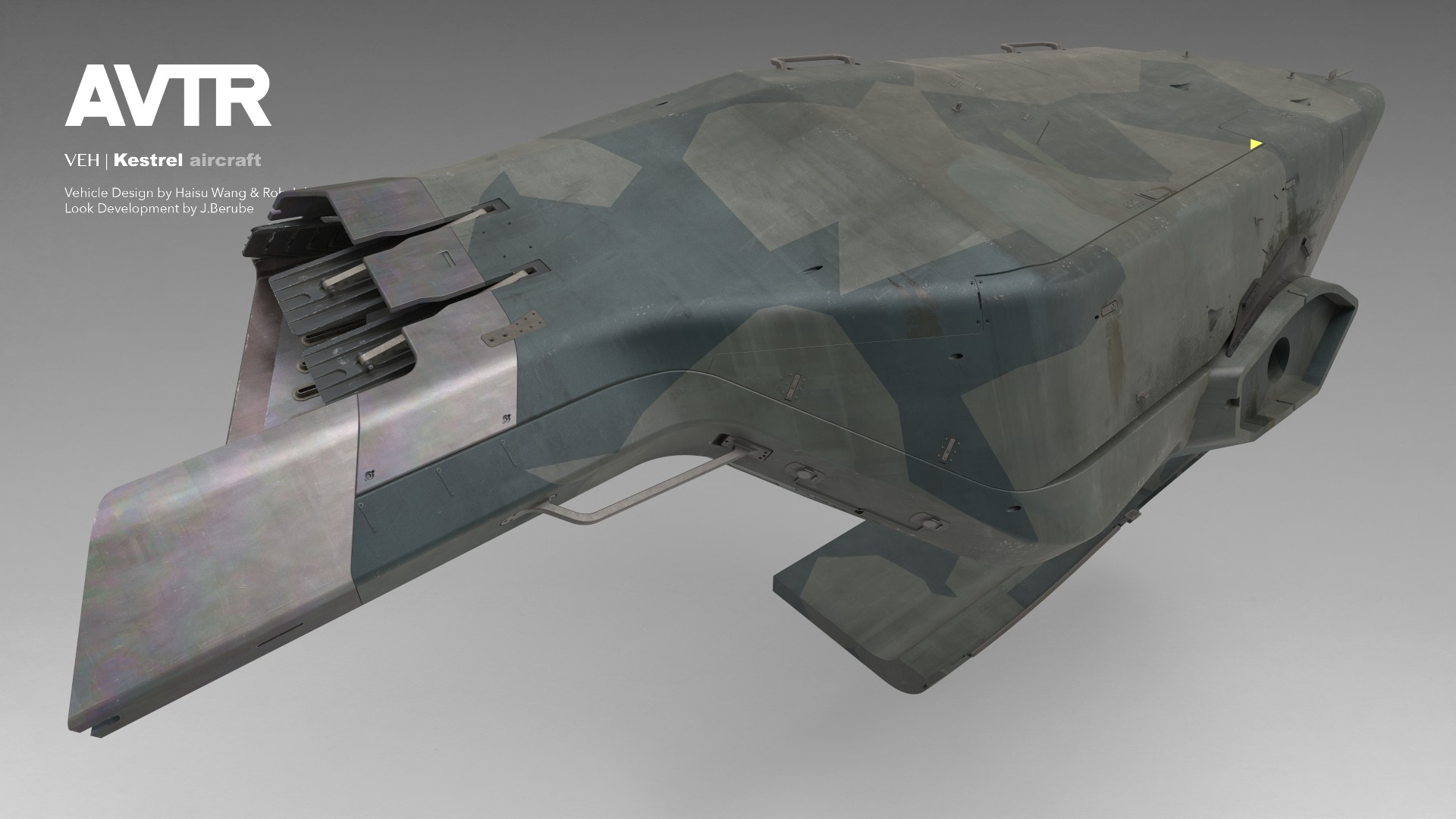
The Kestrel was developed for Avatar: Fire and Ash under Production Designer Ben Procter, with the vehicle designed and CAD modeled by Haisu Wang and its interior designed by Rob Johnson.
My role focused on full look development—establishing the materials, shaders, paint, surface treatments, textures, weathering, and overall visual character. The goal was to create a coherent material language for the aircraft while providing clear visual targets for the teams who would ultimately carry the Kestrel into final VFX.


RDA KESTREL AIRCRAFT
Creative | Pre-Production — Look Development
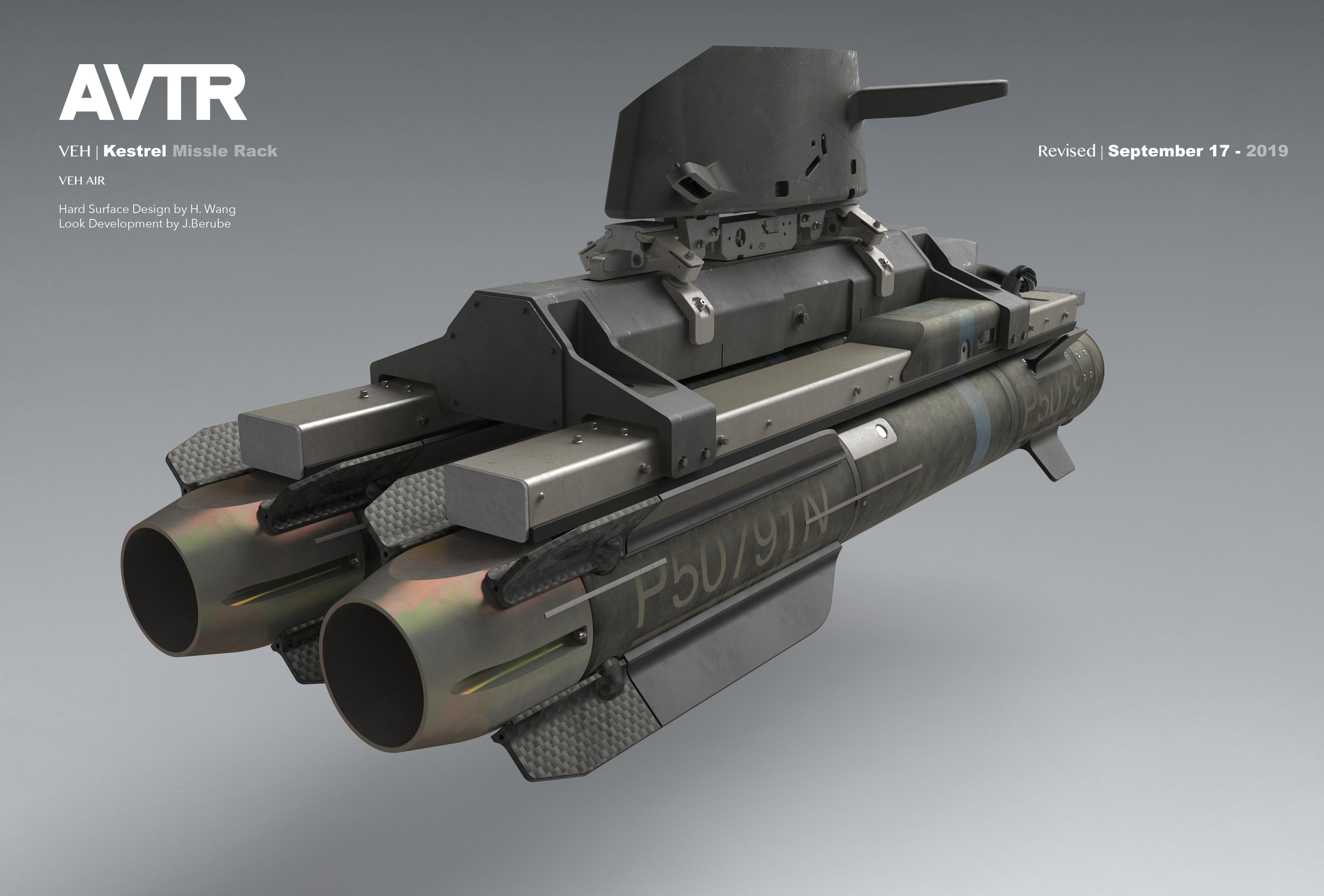
Above: An isolated Kestrel weapons assembly delivered for material and look development.
Below: Individual components developed through the same Material ID–based workflow.
Because Haisu Wang and I were developing the Kestrel simultaneously, we needed a workflow that allowed look development to begin long before the vehicle model was final.
As Haisu completed individual sections of the CAD model, he would deliver those parts to me so I could immediately begin developing the material system—metals, paints, coatings, plastics, glass, weathering, and other surface treatments—while he continued designing and refining the aircraft.
Maintaining consistent Material IDs in SolidWorks allowed Haisu and me to work in parallel as the Kestrel evolved. As he completed or updated sections of the CAD model, I could bring them directly into KeyShot, where the matching IDs automatically retained their existing material and shader assignments. This let me start look development early, build and refine a reusable shader library, and carry that work forward seamlessly as increasingly final geometry arrived. KeyShot was fundamental to this process, allowing design and look development to evolve simultaneously without losing work between revisions.
Instead of waiting for design to finish before look development began, design and look development evolved together.




INTERIOR & PRACTICAL BUILD
Design | Look Development | Fabrication
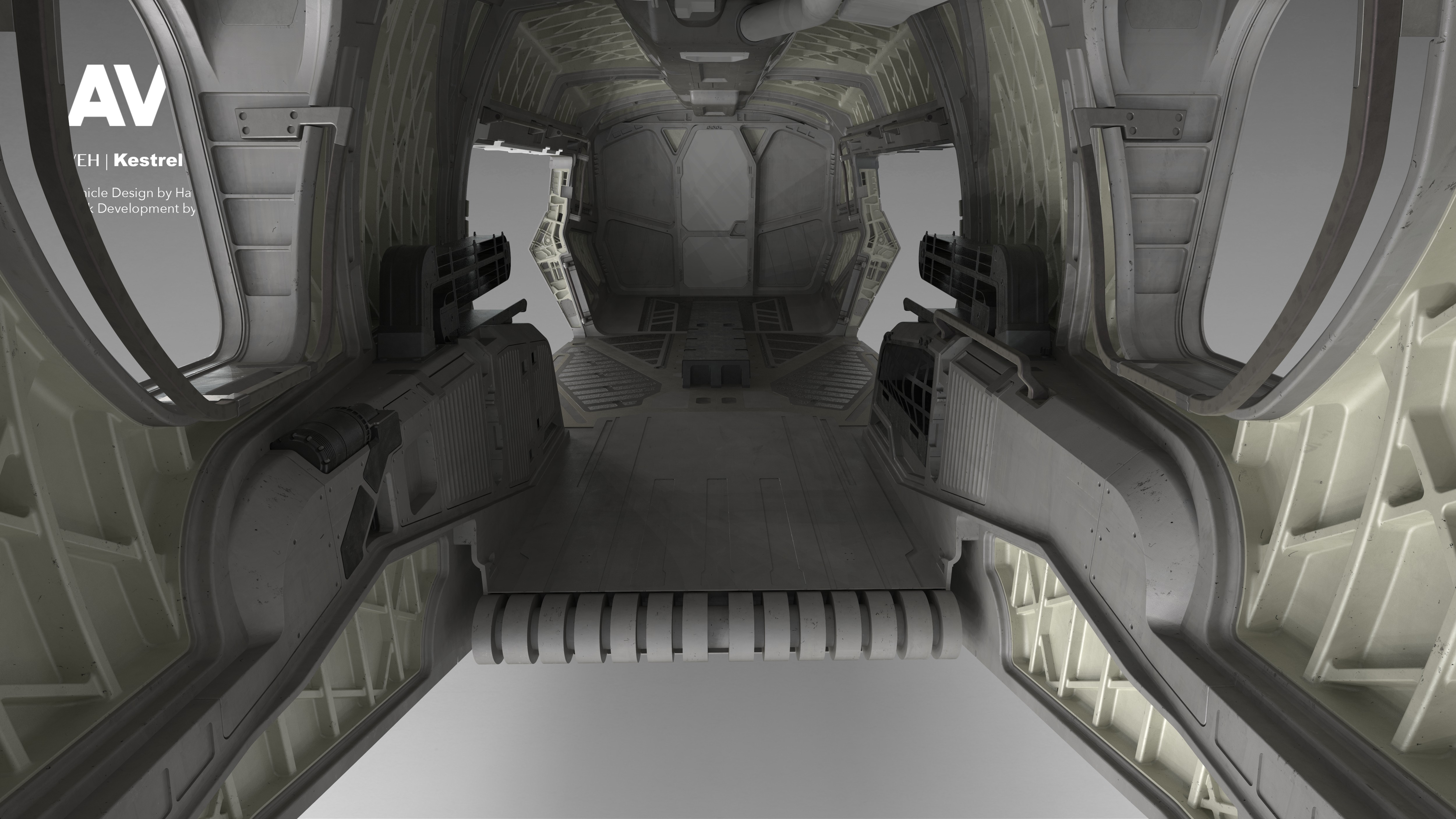
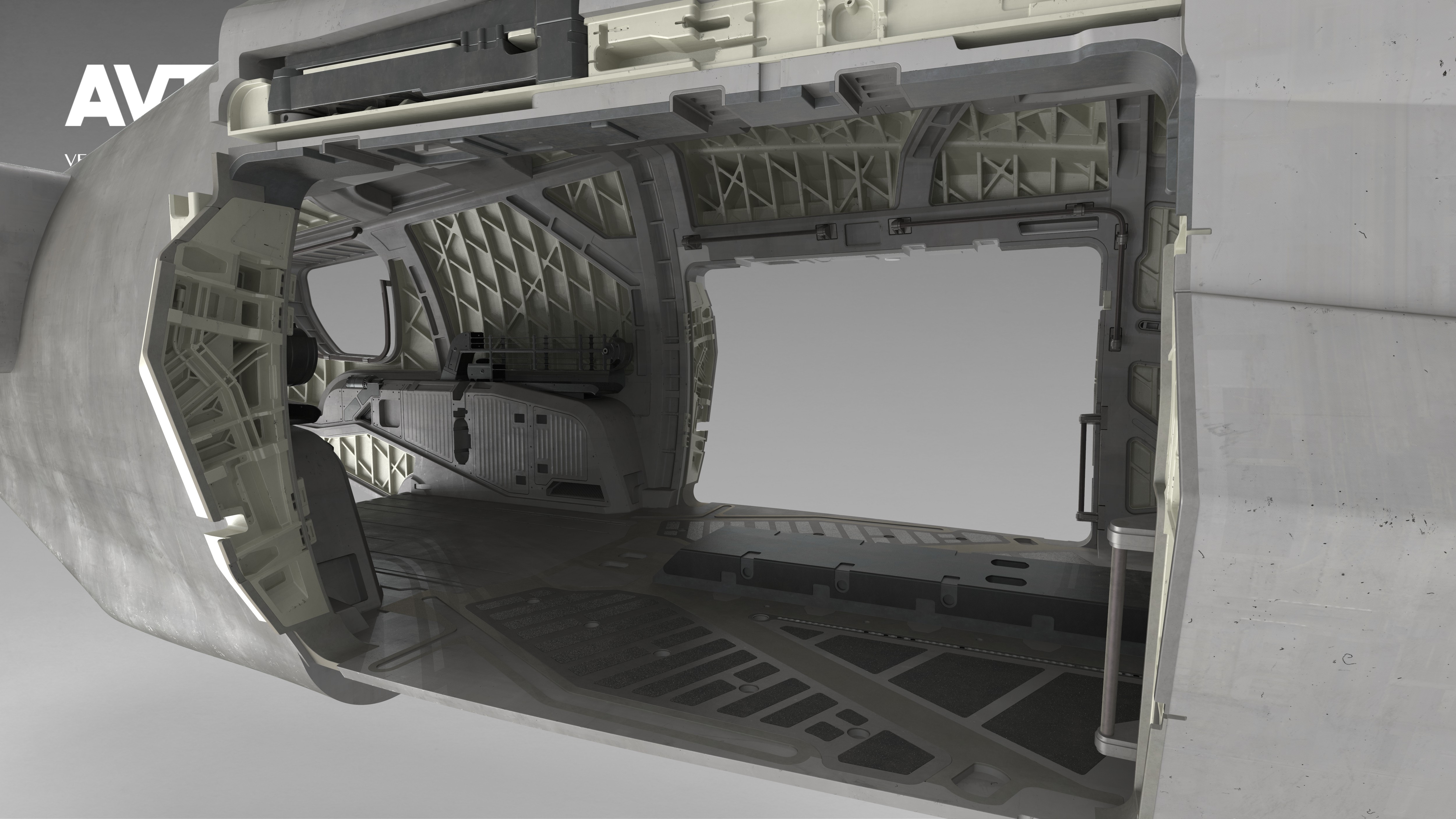
Above: The Kestrel practical build and completed interior.
Below: Interior and ramp LookDev developed alongside the physical build.
One of the most rewarding stages of the Kestrel was seeing the digital work become a full-scale practical build. Under Production Designer Ben Procter, Haisu Wang developed much of the vehicle and CAD design, while Rob Johnson, serving as Vehicle Art Director, led the interior design and oversaw its translation into the physical set.
Because so many sequences involved actors directly interacting with the vehicle, Legacy Effects fabricated an extensive practical build. Seeing materials, forms, and details that had existed on our screens realized at full scale—and with remarkable fidelity—was incredibly satisfying.
In some cases, the physical fabrication and weathering brought even more character to the surfaces. It was a great example of design, art direction, look development, fabrication, and filmmaking each carrying the work forward.





RDA KESTREL AIRCRAFT
Creative | Pre-Production — Look Development
Above: Metallic Anisotropy with VFX Art Direction Paint Over
Bellow: Base Shader prior to Anisotropy treatment.
One of the more specific material challenges was defining the appearance of 3D-printed metal. A conventional metallic shader gave us the correct broad response, but it lacked the directional microstructure characteristic of an additive manufacturing process.
I approached the problem through anisotropy, using the shader's directional response to bend and stretch reflected light across the surface. I then developed a custom knurled texture using a mixer-brush workflow, creating a directional map that could drive the anisotropic response.
The result wasn't simply additional surface texture. The material changed character as the aircraft moved relative to the light—allowing highlights to travel across the microscopic print pattern and giving the metal a manufactured quality that could be read through lighting rather than relying only on painted detail.




RDA KESTREL AIRCRAFT – FINAL FILM
Creative | Pre-Production — Look Development
Above: VFX Art Direction Look Dev Render + Paint Over
Bellow: Final Frames showcasing final VFX and final Color Mastering
Final frames from Avatar: Fire and Ash showing the Kestrel in operation.


The final stage was perhaps the most rewarding: seeing the work come back from Wētā FX as finished imagery. The essence of many of those original keyframes was still there, but elevated through performance, cinematography, simulation, lighting, and final VFX into something far beyond the original painting.
There is something uniquely satisfying about starting with words on a page, creating one of the first visual interpretations of an idea, and then watching hundreds of artists and filmmakers carry that idea forward into the final frame.

NETE ASH CAMP
Creative | Pre-Production — Sequence Design
One of the most rewarding parts of working on Avatar 3 was getting to translate James Cameron’s vision from the script into some of its first images. These keyframe paintings were more than concept art—they were an early attempt to define the sequence itself: the environment, lighting, composition, camera framing, scale, and dramatic intent of the moment.

THE FLUX BATTLE
Creative | Pre-Production — Sequence Design
One of the most rewarding parts of working on Avatar 3 was getting to translate James Cameron’s vision from the script into some of its first images. These keyframe paintings were more than concept art—they were an early attempt to define the sequence itself: the environment, lighting, composition, camera framing, scale, and dramatic intent of the moment.


The final stage was perhaps the most rewarding: seeing the work come back from Wētā FX as finished imagery. The essence of many of those original keyframes was still there, but elevated through performance, cinematography, simulation, lighting, and final VFX into something far beyond the original painting.
There is something uniquely satisfying about starting with words on a page, creating one of the first visual interpretations of an idea, and then watching hundreds of artists and filmmakers carry that idea forward into the final frame.

Vortex Deformation
During the final battle, vehicles approaching the vortex are violently twisted and pulled apart. To explore what that could actually look like, I took Haisu Wang’s Kestrel model into Houdini and simulated the deformation directly.
It was more elaborate than a typical keyframe workflow, but the simulation produced shapes and distortions I would never have designed by hand—giving us a unique visual language for the effect.


What made the process particularly valuable was seeing James later approach those same sequences during production, often using the paintings as a visual starting point. I could observe what he preserved, what he changed, where he moved the camera, and how he refined the storytelling. Seeing those decisions firsthand became an unexpected education in directing—one that has had a lasting influence on how I think about framing, visual storytelling, and designing a sequence before stepping onto a set.


The final stage was perhaps the most rewarding: seeing the work come back from Wētā FX as finished imagery. The essence of many of those original keyframes was still there, but elevated through performance, cinematography, simulation, lighting, and final VFX into something far beyond the original painting.
There is something uniquely satisfying about starting with words on a page, creating one of the first visual interpretations of an idea, and then watching hundreds of artists and filmmakers carry that idea forward into the final frame.